Showing posts with label history. Show all posts

17 September 2014

OMG, Shoes!

What woman does not love a new pair of shoes? While I have tried to keep my personal shoe collection to a bare minimum in recent years, I have had the desire to expand my 19th century shoe collection. One would think a pretty dress is enough when doing living history, but after the umpteenth time of being asked to show someone my shoes, I have realized it is probably time to bite the bullet and invest in some period footwear.

Since I spend most of my time in an 1880s village, I opted for a boot fashionable to that decade. I was fortunate enough to find a pair on clearance in my size, so I purchased them a whilr ago as a birthday present from me to me. When they arrived, my husband commented how they looked uncomfortable. I unlaced one to try it on, and much to my surprise, it actually did not feel all that torturous. Apparently there is something to be said for handmade craftsmanship, quality, and value.

My brand new 1880s style boots!

This made me interested in the history of footwear. Ever since people first began to use footwear, styles have been adapted and updated to meet the trend of the times, but I learned the overall process of making shoes has not changed much in all of those years. The first documented footwear can be traced back to 1495 B.C. Thebes, where pictures of sandal makers graced the walls of an Egyptian structure. Teutonic tribes in Northern Europe wore a leather protection on their legs below the knee. When the Romans came in contact with the barbarians of the north, they adapted their own sandals and shoes to have a similar leg covering.
Boots and shoes were worn throughout the middle ages, and I remember being amused in one of my college history classes when we learned the length of one's shoe was an indication of one's social status in medieval society. The more important you were, the longer your shoe was. While not worn by every person, this exaggerated shoe length can sometimes be found in artwork of the time. Also during the middle ages, cordwainers (shoe makers) and cobblers (shoe repairers) established an association to protect their craft, and it was officially recognized by King Henry III in 1272. This guild is one of the oldest in operation in London today.
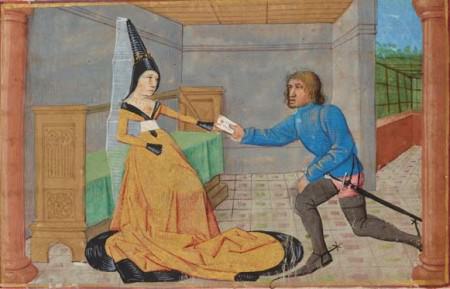
The Romance of Tristan (1468)

The first European shoemakers to arrive in North America were Philip Kertland, who settled in Lynn, in 1635 along with Thomas Beard and Isaac Richerman, who settled in Salem, in 1691. This was a time when a shoemaker could be seen working while wearing a leather apron and using a lapstone, hammer, wooden pegs, handmade thread, and a boot tree last. Apprentices, most often young boys, would learn the trade from master shoemakers.

With a growing industry, regulation was soon to follow. Pennsylvania Province made it a crime in 1720 for a tanner to make shoes. The same act fixed the price of leather and placed a price ceiling on finished shoes for sale. Anything sold above the set rates would be subject to forfeiture. It was a tough trade, and the shoemaker often traveled from town to town in search of business. By the mid-eighteenth century, quite a few cobblers began opening shops and employing others, each tasked with one part of the shoe making process. Near the end of the 18th century, the fledgling shoe industry received a huge boost when the Tariff Act of 1789 was passed, taxing imported goods to raise funds for the newly established United States' federal government.

The 19th century brought about the Industrial Revolution, and while it took longer to gain steam in the United States than it did in Europe, the development of machine technology forever changed the shoe industry. A quick review of technology advancements that came about in the United States during the 19th century:

1815: A machine-made wooden peg began to be used for fastening soles to shoes. Before this time, the bottom of a shoe was most oftentimes merely sewn with heavy thread. (A pegging machine was subsequently developed in 1833 to replace the need of hand-driven pegs, but these machines were not widely used in shoe production until 1857.)

1845: A rolling machine was patented and began to be widely used in the industry. This machine replaced the manual labor of pounding sole leather with a hammer in order to make it firm. What was once a thirty minute process by hand could now be done in about a minute by machine.

1846: Elias Howe patented his first sewing machine, and it did not take long before others such as John Brooks Nichols, a shoemaker by trade, adapted sewing machines to sew with tough leather.


1858: Lyman R. Blake, a shoemaker, patented a machine that could sew the soles of shoes onto the uppers, and Gordon McKay, seeing an entrepreneurial opportunity, purchased those patent rights. McKay had a difficult time selling his machines to shoe factories, which were still doing much of the work by hand with organized teams and outsourced gangs, so he tried leasing the machines instead. McKay's success was probably largely due to the Civil War, since there was a high need for shoes in the country at the time but not enough shoemakers around to fill the demand. William Porter & Sons was the first factory to use the McKay sewing machine in the early 1860s. Part of the leasing agreement was that there would be a stamp on the heel of every shoe to indicate it was sewn by the McKay machine, for which McKay would receive royalties.

1862: A nailing machine was patented, eliminating the need for hand driven nails. Also, August DeStouy patented a machine with a curved needle for sewing turn shoes.

1871: Charles Goodyear received his first of two patents for a machine designed by employed engineers to sew the welt to the bottom of the shoe. This became known as the Goodyear welt machine.


1877: Edge-trimming and heel-trimming machines were patented, which led to some push back from factory workers. Whittlers had been doing this work by hand, and they were paid rather high wages. This was time consuming work as they had to trim the sole and welt of the shoe to a uniform distance around the upper leather; they also had to cut away surplus leather on the heel. The new machines boasted speed, uniformity of work, and savings to manufacturers.

1883: A lasting machine was introduced in factories, and workers organized in opposition to this machine in the workplace. Lasters were paid $20 to $30 per week to pull the leather over the wooden forms that were used to determine the size and shape of shoes and tack it in place to the soles. A hand worker could last about 50 pairs of shoes in a day, working the standard ten hour day that was common in the 1880s; a machine operator could last 300 to 700 pairs of shoes in a day.

There is a reason stories about children going shoe-less in the 19th century during warm weather months are so abundant prior to the late 19th century. In 1863 a pair of handmade shoes took a little over 18 hours to complete, and the cost of labor for shoes was $4.58 on average. Families could not always afford to constantly replace worn out shoes, and so sometimes footwear was reserved for church, other special occasions, and the winter months, when it was needed most. But by 1895 a pair of shoes produced by machine workers could be completed in about two and one-half hours, and the cost of labor for shoes was $0.60 on average. Needless to say the price of shoes declined dramatically by the end of the 19th century.

Thank you, Industrial Revolution along with a little American ingenuity and entrepreneurship! 21st century women who are obsessed with shoes are forever grateful.


08 July 2014

Making Hay

This past weekend at the museum was hay making time, and I volunteered to help with it. I had a general idea of the type of manual labor for which I had enlisted, but since I am fairly active in athletics, I was not too concerned. (If I can hit a stand up triple by crushing a softball over the right fielder's head as her teammates yell for her to get back, I think I can pitch some hay.) My boss, on the other hand, seemed somewhat concerned. There is a lot that can be said about body language, and on that Saturday morning, I was reading quite a bit of doubt in regards to my abilities to pitch hay all day long.

I am a petite woman; I stand all of five foot five and a half inches, just like my German grandmother once was before she shrank in her old age. She weighed 99 pounds after having her third child. My weight tends to fluctuate between 110 and 115 pounds. Scrawniness is just part of my inherited genetics, but one should never judge a book by its cover. Germans and Poles are stubborn folk. :)

The bonnet was borrowed. It was slightly too large for my head, but it protected me from the sun, which is all I wanted.

Since the museum centers around living history, I had borrowed one of the only dresses from our costume shop that fit me. After dressing in all of the appropriate underpinnings, I realized the skirt band was about half an inch to an inch too tight, and the bodice was slightly too long for my torso. It would have to work, though. I even did my hair in an old-fashioned style popular from the 1830s to about the 1850s. At least I was going to look the part!
To be honest, I had never pitched hay in my life before this past weekend. It was going to be a completely new learning experience for me. I knew from last year that the end of June into the beginning of July was when nineteenth century farmers traditionally cut hay. I had watched last year as the men worked the field and pitched the hay up onto the horse-drawn wagon, and then they went to unload in the barn before they started the whole cycle all over again.

Why walk back out to the hay field when you can catch a ride?

For the record, hay is cut grass that has been dried in order to use as livestock feed over winter. Nineteenth century farmers depended on a good crop. In the 1850s in Minnesota, much of the cut hay was wild grasses growing in fields. By the 1880s, farmers were planting tame hay grasses to cut, but alfalfa, often associated with Minnesota, was not popularly planted until the 1910s. (Minnesota Historic Farms Study, 6.255)

For centuries farmers cut hay by hand with scythes, but by the mid-nineteenth century, various types of mowers began to be used instead. Thankfully, the museum's hay was cut by a sickle mower again this year like it was last year. After the field was cut, the hay needed time to dry, and it needed to be flipped over as well so as to dry the other side. Once air-dried, the men folk gathered the hay into small mounds in order to make the hay ready for pitching. Throughout this process, everything needed to be done after the morning dew evaporated, and everyone concerned prayed for no rain lest the hay crop be ruined.

There was no dew on the ground by the time our morning staff meeting was over, so we were able to get started right away on the day we pitched. I sought instruction on technique and then had to decipher for myself as to how I could best replicate the process. The wife of one of my co-workers and a female co-worker also helped with the pitching, which led to many jokes about a story concerning German women working in the fields pitching hay along side the men, much to the dismay some English-American folk in the nineteenth century. Sometimes it was easy to scoop up a large mound, and other times it was difficult. Sometimes only half to a third of the mound caught on the pitch fork. There was definitely a learning curve for me. There was a young boy to help stamp down the hay on the wagon as it was pitched so as to make room for even more hay each load full. Once we had a full wagon-load, the horses hauled it to the barn to be unloaded, pitched inside, and stacked into a hay mound.

Hay was pitched by lifting the mounds onto the wagon.

The men could grab an entire mound in one forkful. I needed a few tries, but I learned do that with smaller mounds.
We have an expert on staff when it comes to building hay mounds. I could probably listen to him spew his knowledge on any subject for hours, so it was entertaining to be instructed by him concerning how to start the mound and how to build up the support wall. He had us newbies walk the mound to feel for ourselves where the weak spots were so he could strengthen that part of the edge. Then, the edge needed to be raked for any loose hay strands, which were tossed back on top of the pile. After all of the hay was stacked, he salted that layer as an extra precaution against any spontaneous combustion later. Then, it was time to water up and head out in the field for another load.

After it was loaded onto the wagon in the field, the hay needed to be unloaded and stacked in the barn for storage.

The work was not too terrible, but it was tough enough that I was visibly perspiring. I learned that I should probably make a better petticoat and starch the heck out of it for future use. I also learned that when you often relegate yourself to the damsel in distress role (because intelligent women know decent men readily jump at the chance to help a lady in need), apparently it leads to an over-concern for one's well-being when hard work is afoot. As appreciative as I was for the fuss by the men folk involved, being asked multiple times in a matter of a few minutes was actually slightly aggravating.

My combative side came out soon after that when one of the men jokingly told me I pitched hay like a girl. Having grown up familiar with the movie The Sandlot, at first I took it as an insult and started rambling off excuses. After a minute or so, I more calmly pointed out that I was a girl. It was a good reminder that of course I am physically incapable of tossing hay mounds of equal size to that of the men, but that does not make the work someone my size is capable of doing any less valid. I may have needed to pitch a few more forkfuls, but eventually I would get the hay to where it needed to go.

Later in the afternoon, we were able to refresh on switchel, made by one of the ladies on staff. Sometimes called haymaker's punch, switchel is a drink concocted of water, vinegar, ginger, and a sweetener of some kind like honey, maple syrup, or molasses. It was the nineteenth century version of Gatorade, and it actually did help reinvigorate the body. Although, I learned the hard way that it is probably not a good idea to guzzle it down while wearing a corset. Oh well, I survived.

A full wagon load heading back to the barn for unloading with our young helper catching a ride atop the hay.

We worked from about 10 a.m. until about 4 p.m. that day, and I only felt my energy start to wain at the very end of the day. Thankfully, it only took one more wagon-load to store the rest of the hay from the field at that point. I was grateful to be done, but I actually had a lot of fun hanging out with the menfolk that day. (I have always felt more comfortable with the male gender than the female gender; it probably has something to do with spending so much time with my older brothers and their friends as a kid since there was no one my age in the neighborhood.) I may have come close to overheating at the tail end after we had finished, but had I a cotton dress instead of a wool dress, that probably would not have been an issue.

It was nice to prove my boss wrong about spindly ladies and manual labor. I was certainly sore the next day, and my injured shoulder from softball is still tender as I type this, but I have been in worse condition from playing in all-day softball and volleyball tournaments than from pitching hay. I guess it helps to be a physically active person. The museum will probably cut hay again close to Labor Day, and I say bring on the challenge. Hard work and honest sweat were valued in the nineteenth century, but having been raised by farm kids, it is something I have been taught to value as well.

(Photos published with consent of the photographer. Copyright © 2014 Lisa Meyers.)


26 March 2014

Maple Syruping

"Roses are red and violets are purple. Sugar is sweet and so is maple syrple." - Roger Miller

Last week and this week has been a busy, not to mention cold, kick-off to our programming season at the museum with maple syrup demonstrations. March is usually the time of year when the temperatures are just right for the sap in the maple trees to start flowing, but it was about ten degrees outside when I left home for work on Saturday. Needless to say, the sap was frozen, just like the ground and just like my fingers as I tried to start my wood burning stove in the old schoolhouse. I am pretty sure all of us in Minnesota are ready for winter to be over and are praying we do not get snow in May again like last year.

Nothing says good morning like a negative five windchill in March. The houses at the museum can be pretty cold before
the wood burning stoves start kicking off heat.

Early springtime, though, is usually an ideal season for collecting sap to make maple syrup. Cold overnight temperatures followed by relatively warm daytime temperatures is the ideal weather for harvesting a bumper crop of sap. (I say relatively here because while everyone in Minnesota knows 40 degrees Fahrenheit is perfect sweatshirt sans jacket weather, folks from other parts of the country are usually bundled up and freezing in those temperatures.) There are four tree types commonly used in Minnesota for making maple syrup and sugar: silver maple (Acer Saccharinum), red maple (Acer Rubrum), sugar maple (Acer Saccharum), and box elder (Acer Negundo). Notice how they all come from the same genus group? Something I learned while becoming familiar with the museum's program a few years ago is that you can tap a box elder tree for sap, and get a fairly decent crop, because it is related to the other maple trees. However, most people collect the sugar maple's sap because it produces the best tasting syrup.

As a high school senior so eloquently remarked to me one day, "Who first decided to make maple syrup? I mean, who in the world first decided that stuff coming out of trees would be good for eating?" Ah, teenagers. He posed a good question, though. While we do not know exactly the first person to discover the sugaring process, we do know of many folktales passed down orally by American Indian tribes. Feel free read a few of the American Indian Maple Tree Legends. Our museum shares the Ojibwe story of "Manabozho and the Maple Trees". If you find those stories entertaining, you can delve into other American Indian Legends.

Early written accounts of American Indian life are often how European settlers learned of the maple sugaring process, as can be found in An Account of the Remarkable Occurrences in the Life and Travels of Col. James Smith. Long before westward expansion brought fur traders to the Minnesota area, American Indian tribes taught European settlers how to make maple sugar. Settlers, in return, often introduced metal ware to the maple sugaring process.

Kids learn how the Ojibwe tribes would look for signs in nature to let them know it was maple sugaring time. American
Indians made large gashes in the shape of a V in tree trunks to gather the sap. Mukuks, birch bark baskets, were put
below the notches to collect the sap. European traders eventually introduced metal drills, spiels, and buckets.

American Indians poured gathered sap into large wooden troughs. Hot stones, heated by fire, were put into the sap to
make it boil and evaporate the water. Kids get to practice moving "hot" stones with sticks from the fire to the trough.

Many of the early settlers in Minnesota learned quite a bit from local American Indian tribes. Supplies to purchase were not readily available for the first settlers, so people quickly developed the skills and techniques needed for making their own supplies in order to survive. Collecting maple sap to make syrup and sugar is one of those crafts that early Minnesota settlers picked up from the Ojibwe and the Dakota. Many folks carved out a decent life on the frontier of Minnesota and lived comfortably after a little hard work. By modern standards, a 21st century child usually considers this lifestyle to be roughing it, but ease and comfort met different expectations in the 19th century.


Boiling sap down to make syrup.

A pitcher of maple syrup waiting to be turned into maple sugar.

The finished product!

In the 19th century, sugar was packed into sugar molds like this one as it was prepared for storage.

Maple sugar was a godsend to frugal American housewives. Sugar cane was extremely expensive in the 19th century since what was produced in the United States' southern region was not enough to meet demand, which meant most of it was imported and subject to tariff. While there is still a tariff on imported sugar cane in the 21st century, the cost of cane sugar compared to maple sugar has flip-flopped compared to the 19th century. The next time you are in the grocery store, take a look at the price of pure maple syrup. I am not talking about the artificially flavored, derived from corn sugar, Mrs. Butterworth or Aunt Jemima syrup. Look at the real stuff. It is not cheap! Now, imagine that is your only option for purchasing a sweetener. Hello, DIY! Had I been living in the frontier of Minnesota in the 1840s, I would have been extremely grateful for the capability of producing my own sugar to use.

Kids get to sample pure maple syrup.

Kids also get to sample pure maple sugar. Teachers just love us. :)

The steps for making maple sugar:
  1. Tap the tree.
  2. Turn the sap into syrup.
  3. Turn the syrup into sugar.
  4. Store for later use.
Simple, right? It is a lot of work, though, considering it takes about forty gallons of sap to make one gallon of syrup. If you keep cooking your syrup down, one gallon of syrup will yield about one pound of sugar. The clean up is usually messy, not to mention sticky. The Minnesota Department of Natural Resources has a wonderful guide for young naturalists who would like to collect their own sap at home. And while you are making your own syrup, do not forget to sing the old New England folk song Maple Sweet


Kids get to enjoy a ride on a trolley pulled by these guys.

Percheron horses are big! I am about 5'6", and I stand at about their nostrils.

As a kid, I remember often putting corn syrup on my pancakes. An old high school friend of mine told me once that was considered poor man's syrup, certainly a 20th century phenomenon if anything. Whether it is poor man's syrup or not, even a bottle of Karo is more natural than the artificially flavored, so-called maple syrups found in stores today. The taste of pure maple syrup is one that cannot be truly replicated. Hopefully, this post is an inspiration to try to include a bottle of real maple syrup in your kitchen pantry. The next time you use some, remember how lucky Americans in the 19th century were to have such a treat at their disposal.


We used a 20th century evaporator to demonstrate for kids how to start the process of turning sap into syrup. The sap
in the evaporator was cooking so long for our school group that it turned into syrup. As the syrup started to boil, it was
not removed from the heat before its combustion temperature was reached. There were flames shooting up from the
syrup before snow was used to extinguish the fire. No children were in danger of getting hurt unless my co-workers are
considered to be children, which is very likely.

A quick chemistry lesson to keep in mind if you plan on making your own maple sugar! Sugar is combustible. As you boil your maple syrup to make maple sugar, the heat is causing chemical reactions to occur at a very fast rate as the water molecules start to evaporate. Removing the syrup from the heat at just the right time allows the reaction process to slow down, but if you forget to remove the syrup from the heat, this process will increase steadily. When this happens, sugar can actually ignite into flames before turning into ash. Author Harold McGee discusses the chemistry of cooking with sugar in his book On Food and Cooking if you would like more reading on the subject. Moral of the story: burnt marshmallows from a campfire are delicious; burnt maple sugar, which has been turned into pure carbon, is not.


11 January 2014

Stylish Hair and Hair Goods

Recently I went to a haircut appointment, something I have not done in over a year. When the ends of my hair started to reach the top of the small of my back, I figured it was probably time to clean things up a bit. And since I was going to most likely cut off about five inches to start with, I figured I could sacrifice the few extra inches needed for a hair donation's minimum requirement. I took the plunge and had my cousin, who is a hairstylist, chop off my golden fine locks, which ended up being close to a foot in length when all was said and done.

Unlike the 21st century woman, Victorian era women rarely cut their hair. I have read about mothers keeping their daughters' hair at shoulder length up until they would reach the age of twelve or thirteen, after which the girls would let their hair grow for the rest of their lives for the most part. On rare occasion, a woman would cut her hair but usually only if she were sick, entering the convent, or in need of money. Hair from convents and women desperate to earn coin was then turned into false hair pieces for purchase. So in the same fashion as the 21st century woman, wearing fake hair was not something out of the ordinary.

 When you look at old photographs and tintypes from the Victorian era, try to keep any feelings of jealousy or envy over the copious amounts of hair in check because it is very likely that the woman with a ridiculously large coiffure is actually wearing a false hairpiece or a padded hair device. Hair switches came in many styles and colors, and a very stylish woman could blend these pieces into her own locks so as to make it look natural, while others were not as successful.


An obvious false hair piece as the woman's hair is blonde
while the wig is darker.

Any woman could stay up on the latest trends by reading the women's domestic magazines of the day, such as Godey's Lady's Book, Harper's Magazine, and The Metropolitan Monthly (later known as The Delineator). As a result, even a woman living in remote, rural areas would have knowledge of the up and coming fashion trends, which she could happily copy to the best of her abilities. While clothing in rural areas may sometimes have been seen as not up to date on the latest fashion plates by some, hair was a commodity that could easily be adapted to the latest styles and trends so as to not look too old-fashioned.

27 November 2013

Street Etiquette

I cannot remember exactly where I found this, perhaps Godey's Lady's Book, but I thought I would share some notes on the proper etiquette that was suggested for gentlemen and ladies in the 19th century. Many of these rules have gone by the wayside, but I find it a fascinating study on 19th century culture.


Street Etiquette for Gentlemen:
  1. Avoid spitting.
  2. Smoking in public suggests low breeding in England; it is accepted in streets of America, but never while with a lady.
  3. Do not loaf around corners and gaze impertinently at passersby.
  4. Do no pick your teeth or nose in public.
  5. When walking with a lady, place her on your side away from the street and danger. Always offer your arm.
  6. If a strange lady stops you for directions, tip your hat or touch its brim while answering.
  7. When walking with a lady and a stranger greets her, respond for her.
  8. If you see a lady on the street that you know, offer a tip of your hat and greeting to her.
  9. Never "buttonhole" a man while speaking with him.
  10. Insist on carrying any parcels a lady is carrying if she is walking with you.
  11. Never step in front of a lady without first saying "pardon me" or "with your permission".
  12. Always take off your glove to shake a man's hand. Never shake a lady's hand in public.
  13. Never walk away from someone or a conversation without first saying "excuse me" or "I beg your pardon".


Street Etiquette for Ladies:
  1. Do not scratch, pick your nose, yawn, or laugh loudly in public.
  2. Do not recognize someone on the street by their Christian name.
  3. Do not offer your hand to shake a man in public.
  4. When walking on a street, avoid eye contact with a strange man.
  5. If a man offers his arm or to carry your parcels, this is acceptable. Say thank you afterwards.
  6. When crossing a muddy or wet street, a lady should lift her skirt and fold it into her right hand. Never lift your skirt above your ankles.
  7. When attending public amusements, wear a bonnet.
  8. If you require directions, you can approach a gentleman for information. Thank him for his help.
  9. Never talk loudly or excessively. Sit with your ankles crossed but never your legs.
  10. If a man tips his hat or bows, you should respond unless he is impertinent.
  11. If leaving an activity or home late at night, arrange an escort in advance. A married lady may go home unchaperoned if necessary, but a single woman should never.


07 October 2013

The Lost Art of Penmanship


There is a fabulous textbook, The Business Guide; or, Safe Methods of Business, published in 1886, in the one room schoolhouse which I have perused through from time to time. In the beginning part of the book, the topic of penmanship is discussed. For someone entering the fields of business during the 19th century, or education for that matter, neat, legible handwriting was of the utmost importance. If you had terrible penmanship, you might not be hired for a job, unlike this century. The English style of script taught in schools from the 1840's until near the end of the century was Spencerian script. While I have seen a few variations on some of the capital letters, there are quite a few differences compared to the Palmer method script, which was introduced to pupils in the 1890's and remained the predominant style of handwriting taught in schools until the mid-20th century. Because of the uniform methodology of the Palmer script, many teachers during this time forced left-handed pupils to write with their right hands. While still a rather decorative script compared to modern styles of handwriting, there was significantly less flourish in the Palmer method than in the Spencerian script.

Spencerian script alphabet, capital letters. While many of the letters are quite similar to modern styles, there are some unique differences. The lower case letters also have a few anomalies from modern script.

Spencerian script, ornamental writing. Many surviving documents from the 19th century are written in a style similar to what is seen here. The Victorians sure had a flair for the ornate!

Ornamental flourishes to penmanship were much more common in the 19th century. I think I could have had some fun with this if my 20th century teacher would have taught it.

Another example of ornamental penmanship, or calligraphic writing by modern standards.

Exercises in ornamental penmanship. There are many options to choose from when adding decoration to your penmanship. It is recommended to hold restraint when adding flourishes.

A less flourished version of Spencerian style script for business use. It would be important for a customer to be able to read any correspondence, and if your writing had a lot of flourish, chances are it would be difficult for a customer to decipher.

While business writing was tamed, a person's signature would never lose its flourish. Even if your penmanship was atrocious, your signature would not suffer the same fate. When writing your own signature, think of our 18th century founding father, John Hancock.

When shipping packages, many businesses used an alphabet similar to this style. I do believe we have a few artifacts at the museum which exemplify this style of script.

Contrary to popular belief, manuscript printing was a style of writing taught in the 19th century. While was is not as prevalent, there were occasions to print instead of write the alphabet.

German script in the 19th century was called Kurrentschrift or Alte Deutsche Schrift. It was based on a medieval Gothic script, and it was amended a bit in the early 20th century to the slightly simplified script of Sütterlin. This style of writing went out of fashion in the 1940s. This is my favorite script to use in my German Lutheran one room schoolhouse simply for the fact that few can read it, even if many recognize it from old family letters.

Later 20th century handwriting consisted of teaching pupils to write manuscript style, block printing, and then transition into cursive style. In a complete about face from the Palmer method's tendency to assimilate left-handed writers, modern handwriting books gave instruction for both the left-handed and right-handed child. (Phew, thank goodness for me since I am a lefty! I have heard many stories from my mother about her teacher forcing her to write with her right hand.) For those who began attending elementary school in the 1980's like me, one might be familiar with a third style of writing called D'Nealian. The script was meant to show the beginning of a curve in letters so as to make the transition to cursive easier. Some schools still use this style of instruction today.

The Palmer method replaced Spencerian style in the very late 19th century and dominated school classrooms until the mid-20th century. While still rather ornate, it is a much simpler form of writing than Spencerian script. It is during this period many teachers forced left-handed writers to switch hands.

Zaner-Bloser developed a block printing style to teach the youngest of students in the later 20th century. This is a style still used in many classrooms today in which students first trace the letters then write the letters independently. There are still proper strokes to be followed when writing.

The transition to cursive writing in the Zaner-Bloser method was meant for the third grade and utilizes the same technique as printing. The student first traces the letters then writes the letters independently. If you were in elementary school during the 1970's or later, chances are you learned this style of script.

The transitional method sometimes taught in the late 20th century was D'Nealian. Like Zaner-Bloser, many schools still use this style of script when teaching children how to write. Some have altogether replaced cursive writing with this technique.

Heading into the 21st century, I am astonished to hear how many schools have dropped handwriting from their curriculum. For some reason, many educators making these decisions consider penmanship to be obsolete in a world of technology and computers. I joke that one day the Declaration of Independence is going to look like hieroglyphics to future generations of Americans, but sadly, it could possibly become a reality. When I portray a 19th century schoolmistress, there are many visitors my age and younger who cannot read my handwriting on the blackboard. It should be noted, when writing in English, I use Spencerian script with as little flourish as possible while writing on the blackboards.

A little humor. Is penmanship really obsolete? Have computers really taken the place of handwriting? Or do some just consider it to be no longer necessary because of the patience good handwriting requires It is not something to be learned overnight but to be perfected with much practice over many years.

I do not mean to give teachers a bad reputation for decisions often made beyond their control. Many 21st century teachers continue to teach penmanship to their students. Handwriting Without Tears is a penmanship curriculum I frequently hear mentioned by today's teachers, and there is a variety of published curriculum available for use, thankfully. There are also parents of children who are taking the initiative to teach penmanship to their children after the schools their children attended remove it from the classroom. This exercise in fine motor skills is still relevant and important in 21st century education, and kudos should be given to those still trying to keep it alive. I have seen second grade boys rush through assignments and turn in papers with printed script written backwards yet cursive script written correctly. There is some logic in keeping penmanship in the classroom.

Printed manuscript for Handwriting Without Tears. It seems simple and straightforward. Added bonus: its name suggests a promise of zero crying children. ;)

Cursive script for Handwriting Without Tears. It uses a vertical letter instead of incorporating any slant. Personally, it is an ugly script, but if child is learning cursive one should not complain.

So, the next time you sit down to hand write something, keep in mind the Victorian advice to scholars of business for practicing and perfecting the eloquent art of penmanship:

How to write.
A complete set of rule for position and practice.


  1. Sit in an upright and easy position. It will add to the ease and beauty of your writing. Keep both feet on the floor.
  2. Hold the pen firmly, but not so tightly as to cramp the fingers.
  3. Place the hand on the paper so the top of the holder will always point over the right shoulder. This will cause the points of the [steel] pen to press equally on the paper.
  4. Keep the wrist from touching the paper or desk, and keep the thumb from bending while writing. Avoid the finger movement. It's not practical.
  5. Let every downward stroke of the pen be drawn towards the center of the body, and the writing will have the correct slant.
  6. Never practice carelessly. Always practice with a free and quick stroke. Let the movement be bold, free, offhand, resting the pen so lightly that the arm, hand and fingers can move freely together.
  7. In making the shades, press on the pen with a gentle, springing movement. It will avoid heavy and irregular strokes.
  8. Heavy shading, or shading every downward stroke, never adds beauty nor grace to the writing.
  9. The thoughtful student in penmanship, as in other studies, will win. Think and write. Practice with perseverance, and your success will be certain.
  10. To make the greatest improvement in the shortest time, practice upon the letters separately until you can make them all correctly.
  11. Flourishes, too heavy shading, too large or too small letters, should be carefully avoided.
  12. Practice writing by copying business letters, notes, drafts, receipts, etc., and you will improve your knowledge of business as well as your penmanship.


12 September 2013

The Coolest Job in the World

I gave a tour today to a group of senior citizens. It was a family reunion apparently, and there were people from Minnesota, Wisconsin, Iowa, Colorado, and Washington. Quite often this particular program is given to a group of students with no absolutely no recollection of life before the Internet. That can be an enjoyable time showing young people how different life used to be and how easy life is now compared to not too long ago. However, giving a tour to people who have actual memories of things on the tour is a whole different experience.

We started in the town hall of our little historical village, which according to a picture caption I saw recently, used to be a one room school. Every person in the group had attended a one room schoolhouse as a child. One gentleman mentioned how there were 11 kids in his school, while another said he was the only 5th grader in his school. Yet another gentleman talked about how there were five kids at the one room school when his family moved to a new town and a woman joked about how the school population doubled after his family started attending it.

I shared with the group that my mother's family attended a two room country school located on the edge of my grandfather's farm. I grew up listening to stories about what school was like for them. My uncle in particular was not the best of students. Their teacher always bent over at the waist to help a child at his or her desk, and she happened to be assisting the student sitting in front of my uncle one day after he sharpened his pencil to a very fine point. Being the focused student that he was, my uncle sat in his desk holding his pencil out just behind the teacher's derriere as she helped his classmate. When the teacher backed up, her backside ran right into the pencil. She told me uncle to get up, but he would not listen. After some frustration, she tried to pull him out of his seat. My uncle was wise enough to grab onto the desk and wrap his legs around the legs of his chair as she tried to force him out of his seat. The one problem the teacher did not consider was that if you tug at a child grasping for dear life onto a desk which is part of a row of desks attached to runner-boards, there is going to be some resistance. Well, she pulled on him hard enough that she tipped the whole row of kids over that day. I do not remember what happened to my uncle after the fact nor what happened when he arrived home from school that day, but I love that story. My group of senior citizens found it just as amusing.

Making jokes about using an outhouse in the middle of winter in the upper Midwest is something that appealed to this group because they lived it for so many years of their lives. At first I described it sarcastically as fond memories for them, but one of the gentlemen corrected me while laughing that there is never a fond memory about an outhouse. Considering my grandmother did not install indoor plumbing in her farmhouse until the mid 1990's, I can certainly agree, but I always cheated at grandma and grandpa's house and used the indoor toilet grandpa had rigged up so as to save myself the walk outside near the end of December.

The familiarity many had with the wood burning cook stoves manufactured in the 1880's in a few of the houses was unique to their generation. A gentleman talked about how the warming ovens were a perfect place to store a pair of mittens, especially wet ones, to warm. Another mentioned the hot water reservoir on the side of the stove in the house he grew up in. One of the ladies in the group talked about how handy it was to take water from the side of the stove on bath night. Using the wet sink, which would pump collected rain water from a cistern into the kitchen, for washing and bathing was not unfamiliar to this group. Bath night was on Saturdays in the nineteenth century just as it was for this group throughout their childhoods, and everyone shared the same bath water. The only thing that differed, it sounded like, was the bath order. In one family, the ladies bathed first. In the nineteenth century oftentimes, it went oldest to youngest. The baby went last, hence the phrase "Don't throw the baby out with the bath water".

The fact that this group could recognize the washing "machine" and the cider press in one of the houses showed they really lived in much of the history we were reliving on the tour. The ladies and gentlemen could tell of how their families' wringer washers were similar or different to that of the laundry items sitting before them. Or the fact that many recognized the antiquated irons displayed the deep memories the ladies had for sad irons with removable wooden handles as well as the early steam irons, used with kerosene in the nineteenth century but with gasoline in the twentieth century when these ladies were younger. As one lady described it, "Very dangerous!" The green Ball canning jars brought smiles of recognition, and the Singer sewing machine led to a few family stories. They played with stereoscopes as children. The root cellar was a place to joke about how when some of the men were in trouble as boys, they had to sit on the top step of the cellar as punishment. In the doctor's office at the end of town, a gentleman laughed when he saw the hearing device which looked identical to one he remembers his great-uncle using.

I joked during a bathroom break that someone should take over the rest of the tour. When it comes to historical knowledge taught at the museum, their hands on, lived through it experience tops anything I can ever read about. I made sure to thank them for sharing their stories with me because I can use it in my interpretation for future groups. Even though they grew up in the early to mid twentieth century, their childhoods resembled more of a nineteenth century life than a twenty-first century life.

There were a few things the group was less familiar with such as nineteenth century clothing styles, ladies' undergarments, the misconceptions about corsets, and the potent effects of late nineteenth century prescription medicine. I get to teach history, but I almost enjoy listening to the stories people have to tell more. Ask any senior citizen who grew up in the rural Midwest what year they got electricity and I guarantee they will have an answer for you. This group did, and being they grew up in Iowa, they even had electricity before both sets of my grandparents did. Ask someone from that generation about a party line and you will see the eyes light up. Now, party lines are a twentieth century thing, but we were reliving their childhoods as we walked to their vehicles at the end of the tour.

The aging generation has many memories to be shared, and if it is not written down, much of that becomes lost to history. I get to retell these memories on a regular basis, and I get to help a little bit of someone live on through a story. This is the reason why my job is the coolest job in the world.